DevRecall keeps an on-device, embedding-searchable index of your
work. Ask it questions, or let it write the routine docs for you.
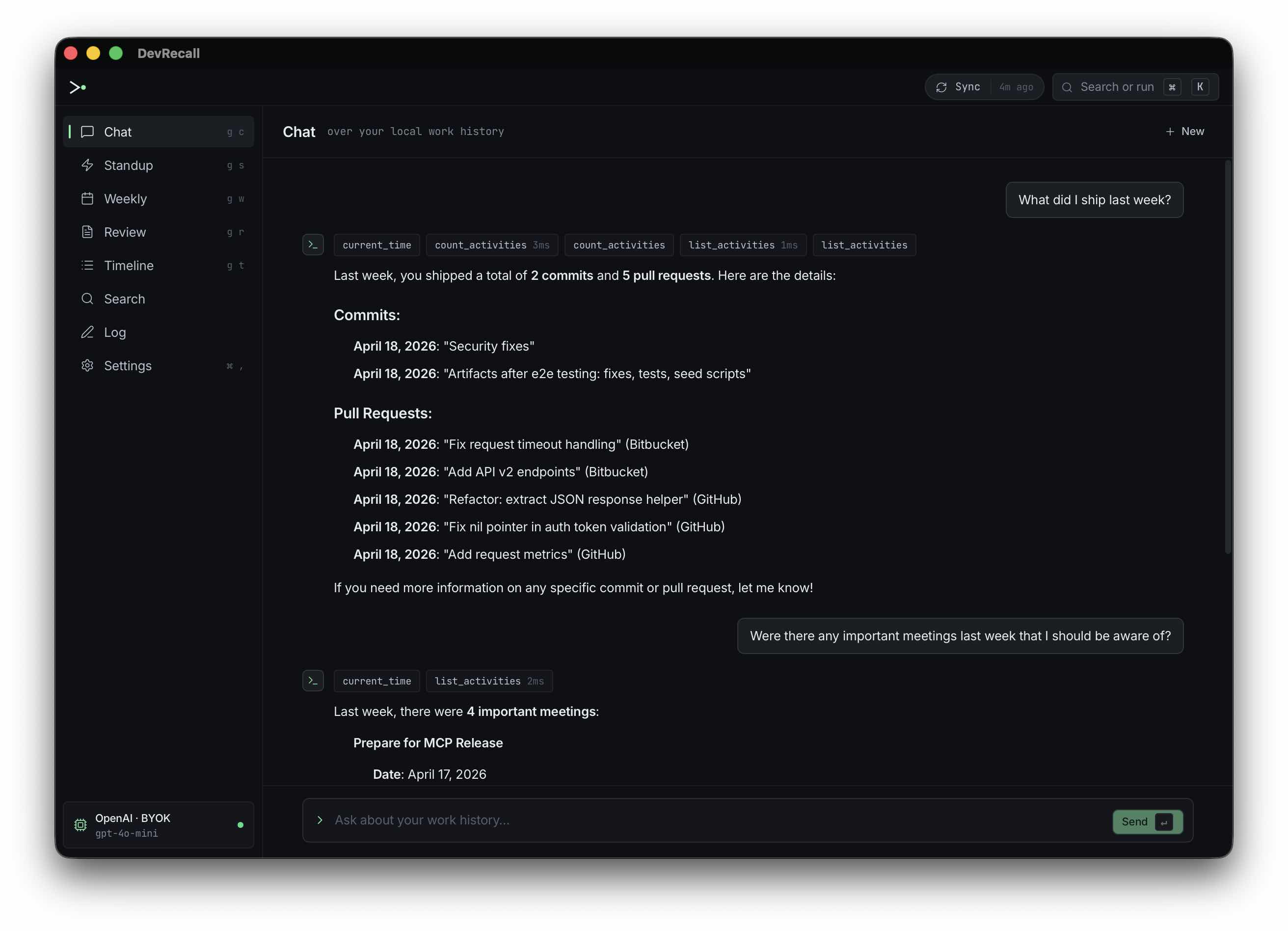
Chat your work history
An agent with read-only tools over your local index — FTS5
keyword search, vector search, date and source filters. Ask
"what was that auth bug I fixed in February?" and it
filters by date, then semantic-matches. Every answer cites the
rows it read; nothing is invented.
Memory for your coding agent — and of it
Ships an MCP server out of the box — any MCP-compatible
coding tool (Claude Code, Cursor, Codex, Continue, Zed) can
spawn it as a stdio subprocess and gain search, citations,
and decision history over your local index.
/devrecall:recall what was that auth bug returns
cited PRs and commits inline — no leaving the editor.
It reads the other direction too: DevRecall indexes your
Claude Code sessions straight off disk, so a day spent pairing
with an agent isn't invisible just because it produced no
commit. Sessions on a ticket branch get grouped with that
ticket's commits and PRs.
Standups, weeklies, brag docs
devrecall standup writes "yesterday / today /
blockers" from real signal. Weekly roll-ups for Monday and
quarterly brag docs for perf review — sourced from data, not
memory.
Identity merge
Collapses your git email, GitHub handle, Slack ID, and Jira
account into one "you". Works across orgs.
Local model, or yours
Defaults to local Ollama. BYOK for Claude or GPT. Embeddings run
on-device via bundled ONNX — no GPU required.
CLI and desktop app
Single Go binary on macOS and Linux. Native macOS app wraps the
CLI for menu-bar use.